Olivier Van Herpt Explores ‘Machine Drawing’ in 3D Printed Porcelain
Dutch ceramic artist Olivier Van Herpt has unveiled a new series of large-scale, 3D printed porcelain vases that blend human-made 2D imagery with automated extrusion. By overcoming porcelain’s notorious 30% shrinkage rate, his custom workflow turns the 3D printer into an active creative partner.
Published: April 5, 2025 • Original report: 2025-04-02

Dutch artist Olivier Van Herpt has spent the past decade pushing the boundaries of ceramic additive manufacturing, building a reputation for experimental vases and sculptures. Known for his 2017 series that reimagined traditional blue Delftware using cobalt-infused 3D printed porcelain, Van Herpt is now turning his attention to a colorful new collection that explores the concept of “machine drawing.”
Working with porcelain in 3D printing is notoriously difficult, as the material is prone to warping and structural failure. Yet Van Herpt’s latest series demonstrates how custom hardware and a novel material-feeding technique can produce large, thin-walled porcelain vessels adorned with vibrant, impressionistic patterns.
Rather than treating the 3D printer as a passive tool that merely executes digital code, this project positions the machine as an active collaborator. The resulting pieces—including a striking 63 x 31 cm vase—showcase a unique fusion of human artistry and mechanical interpretation.
Key Highlights & Specifications
- Artist: Olivier Van Herpt (Netherlands), a 10-year veteran in 3D printed ceramics.
- Material: White porcelain base combined with colored porcelain details.
- Featured Dimensions: 63 x 31 cm (for the primary pictured vase).
- Shrinkage Challenge: Addresses porcelain’s tendency to shrink up to 30% during drying and kiln firing.
- Custom Hardware: Utilizes a specialized 3D printer featuring a tall build frame and a fine nozzle for thin-wall extrusion.
- Firing Protection: Employs 3D printed saggars (protective containers) to shield the delicate porcelain during firing.
From 2D Slab to 3D Form: Inside the Extrusion Workflow
The “machine drawing” process begins long before the 3D printer starts moving. Van Herpt first creates a two-dimensional image by combining a white porcelain base with colored porcelain details—in this case, forming the shape of a flower. This flat, two-dimensional slab is then rolled around a porcelain core to create a solid cylindrical clay cartridge.
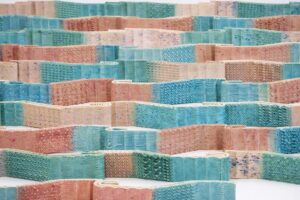
Once prepared, the cylindrical piece of clay is fed directly into the custom 3D printer. Using a fine nozzle, the machine extrudes the porcelain in delicate filaments, building the cylindrical vase layer by layer. As the clay is extruded and deposited, the original 2D floral image is stretched and translated into a softer, almost impressionistic design across the surface of the vessel.
To ensure these large, thin-walled pieces survive the transition from wet clay to finished ceramic, Van Herpt had to solve porcelain’s biggest limitation: extreme shrinkage. Because porcelain can shrink by up to 30% in the kiln, larger 3D printed structures historically cracked or collapsed under their own weight. Van Herpt overcame this by developing a controlled drying process and utilizing 3D printed saggars to protect the pieces during firing. As he recently explained to Hypebeast: “Porcelain is generally kept small because it collapses in the firing process, but with this machine, I can make very thin, large pieces that do not collapse.”
Redefining Human-Machine Collaboration in Ceramic Art
For ceramic artists, makers, and architects, Van Herpt’s latest work highlights a major step forward in material control. Demonstrating that large-scale, thin-walled porcelain can be reliably printed and fired without collapsing opens up new possibilities for architectural ceramics and bespoke sculptural design.
Beyond the technical achievement, the project challenges conventional notions of digital fabrication. Instead of aiming for sterile, exact replication of a digital file, Van Herpt embraces the unpredictability of the physical medium and the mechanical process. “Instead of silently obeying code, the approach is the opposite,” Van Herpt noted. “Both human and machine take part in the creation and ideation of the final result, impacting how it looks.”
Source & Project Documentation