Lithoz and Evove Unveil 3D Printed Ceramic Filter Membranes at Formnext
Lithoz and Evove showcased advanced Separonics ceramic filter membranes at Formnext 2024, manufactured using the CeraFab S320 system. This high-performance lithography-based ceramic 3D printing application significantly improves industrial water recycling and lithium extraction efficiency.
Published: November 22, 2024 • Original report: 2024-11-19

Revolutionizing Industrial Filtration with Lithography-Based Ceramics
High-performance ceramic 3D printing specialist Lithoz has taken center stage at Formnext 2024 by featuring the Separonics ceramic filter membranes developed by Evove. Engineered specifically for critical industrial applications like lithium extraction and industrial water recycling, these advanced components demonstrate the massive potential of ceramic additive manufacturing in solving complex global challenges. By utilizing cutting-edge manufacturing techniques, this collaboration addresses longstanding industry hurdles such as high production costs and inconsistent filtration performance.
The integration of lithography-based ceramic manufacturing (LCM) allows for the precise engineering of custom geometries that dramatically enhance flux, selectivity, and overall durability. According to the companies involved, this innovative approach yields a fivefold increase in output, slashes energy consumption by an impressive 80%, and facilitates 80% more water recycling. As industries worldwide face escalating pressures to adopt sustainable practices, this development proves that advanced ceramics can be scaled cost-effectively to support the circular economy and drive decarbonization.
Key Highlights & Specifications
- Manufacturing Hardware: Produced using the Lithoz CeraFab S320 3D printer, which features a 246 x 130 mm build platform, a 60 µm resolution, and a 4K projection system optimized for mid-sized industrial components.
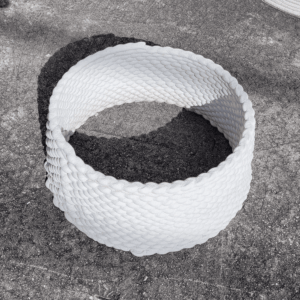
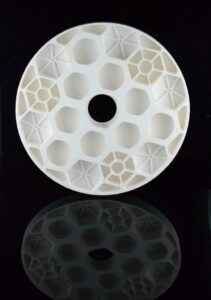
- Filter Module Dimensions: Formed by stacking 20 ceramic segments—each measuring 10 cm in diameter and 5 cm in height—into a total filtration module length of 1 meter.
- Material Choice: Durable alumina ceramic was selected for its exceptional resistance to high temperatures, aggressive chemicals, and physical wear.
- Performance Metrics: Achieves a 5x increase in output, an 80% reduction in energy consumption, and an 80% increase in recycled water compared to traditional methods.
- Exhibition Location: Featured at Formnext 2024 at Lithoz’s Booth C49, Stand 11.1.
Materials, Mechanics, and Workflow of Ceramic 3D Printing
The creation of these groundbreaking membranes relies on Lithoz’s proprietary CeraFab S320 system, a machine designed for the industrial-scale production of mid-sized ceramic parts with fine detail. The workflow harnesses advanced LCM technology, which uses photopolymerization to selectively cure ceramic-filled liquid resins layer by layer using a high-resolution 4K projector. This additive process eliminates the need for expensive tooling, thereby accelerating production timelines and lowering overall manufacturing costs.
Material selection plays a critical role in the success of the filtration modules. Alumina ceramic is chosen for its rugged structural properties, allowing the filters to withstand harsh operating environments characterized by extreme temperatures and corrosive chemical exposure. Furthermore, the 3D printing workflow enables exact control over porosity, permeability, and structural strength, ensuring a uniform pore size and distribution across the entire 1-meter stacked module. This precise digital fabrication results in superior operational efficiency and a longer lifespan compared to conventional polymer-based filtration alternatives.
Impact on Ceramic & Clay 3D Printing and Sustainable Infrastructure
For ceramic artists, industrial makers, and architectural innovators, this deployment highlights the expanding boundaries of ceramic additive manufacturing. Moving far beyond traditional pottery or decorative pieces, high-precision ceramic 3D printing is now proving its worth in heavy industry, environmental engineering, and vital resource recovery. The ability to customize complex internal geometries without tooling opens new avenues for creating functional architectural ceramics and environmental remediation structures.
As demonstrated by ongoing academic and industrial research—such as 3D printed ceramic-infused lattices removing PFAS ‘forever chemicals’ and rapid membrane production facilities—ceramic 3D printing is rapidly evolving into a frontline tool for sustainability. By overcoming historical limitations related to manufacturing scalability and structural cost, innovations like the Separonics membranes validate the transformative power of advanced ceramic additive manufacturing in addressing critical global challenges like clean water scarcity and responsible resource extraction.
Source & Project Documentation
Primary Sources:
Related Links & Files: